
What Is SAP’s “Autonomous Enterprise”? A Simple Explanation
Here’s the easiest way to understand SAP’s Autonomous Enterprise vision – no jargon, just the chain of events.
Today: A Lot of Humans, A Lot of Steps
Picture a company running on SAP right now. A supply chain problem comes up. Here’s what usually happens:
That’s a lot of people, a lot of screens, a lot of hand-offs – and a lot of time lost between each step.
Tomorrow: Humans Give Direction, AI Executes
SAP’s vision flips this around. Instead of a person manually working through every step, it looks more like this:
Human → AI Assistant → AI Agents → SAP Systems
The human just says:
From there, the AI takes over the coordination:
That entire chain, running on its own with a human still in the loop – that’s what SAP calls the Autonomous Enterprise.
Stay Ahead in the SAP + AI Era
Join 10,521+ SAP Professionals mastering SAP AI every week. No spam. Unsubscribe anytime.
Why SAP Thinks It Can Do This Better Than Generic AI
A general AI model is smart, but it doesn’t automatically know how a specific company works. It might not know which supplier provides which material, what the approval policy is, or who’s even authorized to approve a transaction.
AI needs business context to act reliably – and SAP believes it already has that context, because so many companies already run their finance, procurement, HR, and supply chain through SAP. That gives SAP three advantages:
Process knowledge
SAP understands how enterprise processes actually connect and unfold, end to end.
Business data with meaning
Not just Customer = 100034 – the full relationship: Customer → Contract → Order → Product → Delivery → Invoice → Payment.
Governance
AI can’t act freely. Approvals, authorization, compliance, and audit trails keep every action controlled and traceable.
What SAP Is Actually Building
The whole plan comes down to five connected pieces.
Joule – the front door
Instead of clicking through apps and screens, you just tell Joule what you want. Joule figures out what data, workflows, and agents are needed to make it happen.
Joule = the front door to SAPSAP Autonomous Suite – where the work gets done
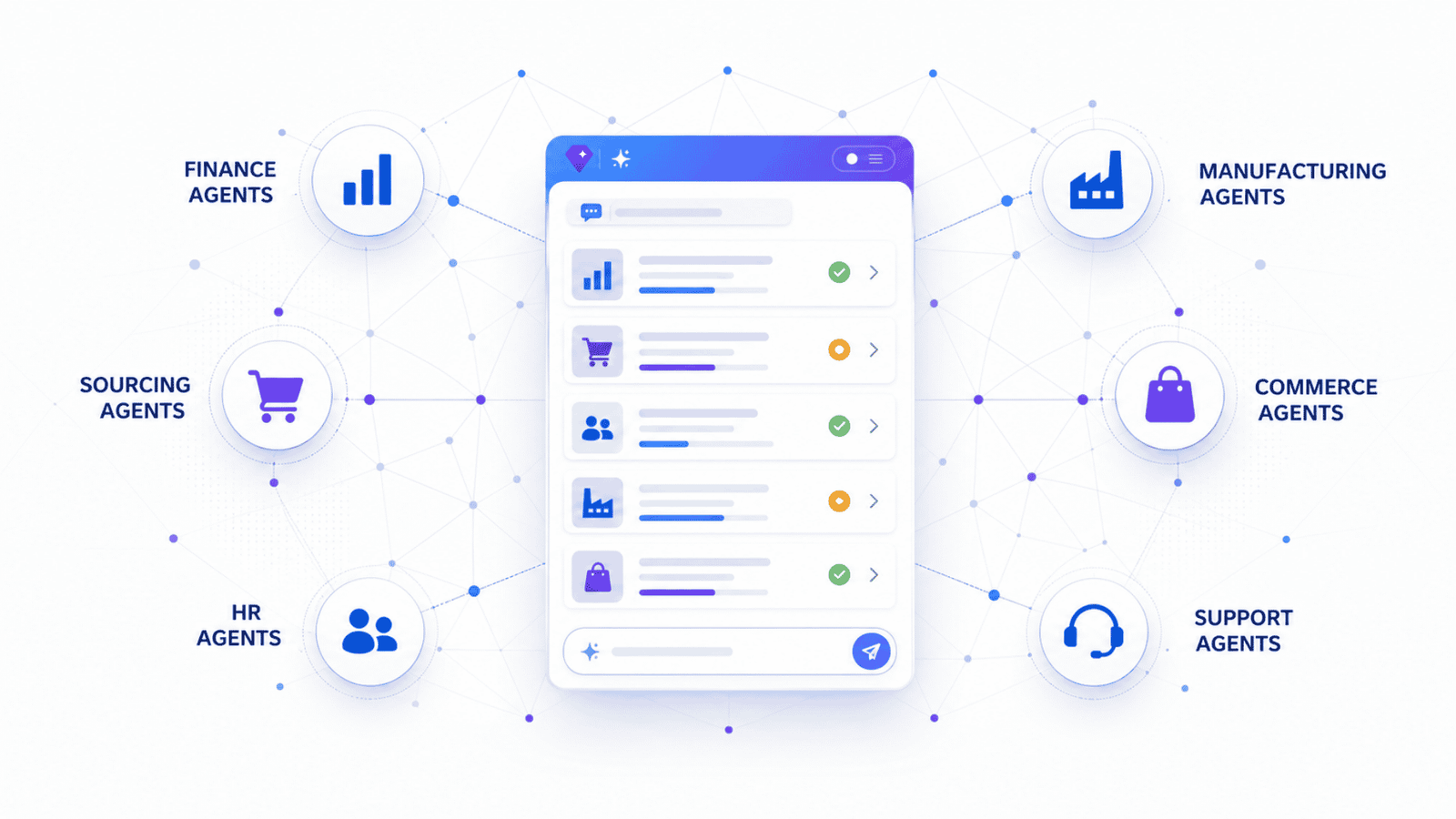
Spans five areas: Finance, Spend, Supply Chain (SCM), HCM, and CX. Each runs on a mix of assistants (who coordinate the work) and agents (who actually perform it) – for example, a Finance Assistant coordinating an Invoice Agent, a Payment Agent, and a Reconciliation Agent.
Agents are the doersIndustry AI – knowledge specific to your industry
Generic finance knowledge only goes so far – banking, manufacturing, healthcare, and retail all run differently. SAP builds AI with industry-specific processes, data models, and regulations baked in.
Vertical depth, day oneSAP Business AI Platform – the engine underneath
Brings together SAP Business Technology Platform, SAP Business Data Cloud, and SAP Business AI in a governed environment. Its purpose is to help companies build, contextualize, reason, and govern enterprise AI.
Build · Contextualize · Reason · GovernRISE/GROW + AI – getting companies there
Most companies still run older, customized systems. SAP uses AI agents to speed up the migration itself: Old ERP → AI-assisted transformation → Cloud ERP → Autonomous Enterprise.
The migration pathPutting It All in One Picture
RISE with SAP and SAP GROW provide transformation paths that can help companies modernize their landscapes and move toward this architecture.

SAP AI Skills
Very few have SAP AI skills.
The Bigger Message
It’s not “AI will replace SAP.”
The interface may increasingly become AI. The actual work may increasingly get done by agents. But those agents still need trusted data, clear processes, and solid governance underneath them to act reliably.
SAP is evolving from software that humans operate, into a platform where humans set direction, Joule understands the intent, and AI agents carry out the work – grounded in SAP’s data, processes, and governance. That’s what the Autonomous Enterprise really means.
Learn more from SAP: Explore SAP’s official overviews of the Autonomous Enterprise, Joule, and the SAP Autonomous Suite.

Alma TA is SAP AI Solutions Director at Zequance.AI, specializing in SAP Business AI, Joule, AI Core, and generative AI on SAP BTP. Drawing on her background in data science and enterprise analytics, she turns complex SAP AI concepts into practical guidance for consultants, architects, and business leaders.