AI Agents in SAP: The Complete, Simple Guide to How They Work and Where They’re Used
AI agents are showing up everywhere in SAP conversations right now. Here’s the full picture – how they’re built, the different kinds that exist, and exactly where they’re already doing real work.
What Is an AI Agent, Really?
Think about the tools you already use in SAP. A report runs when you click a button. A workflow moves forward when you approve a step. Everything happens because a person told it to happen, right when it happened.
An AI agent is different. Instead of waiting for a click, it can:
- Understand a goal (“resolve this invoice dispute”)
- Figure out the steps needed to get there
- Go do those steps itself
- Adjust if something unexpected comes up
That’s the core shift. A traditional tool follows instructions. An agent pursues an outcome – which is why people describe it less like software and more like a digital colleague, one you can hand a goal to and trust to work through it.
How an AI Agent Actually Works: The Five-Part Engine
Underneath the surface, every capable AI agent is built from five connected capabilities. Understanding these makes everything else in this guide easier to follow.
Language understanding
The agent needs to understand plain, everyday instructions – not rigid commands. This is what lets someone type “follow up on the Hopcom payment dispute” instead of navigating six screens.
Planning and adaptability
Once it understands the goal, the agent maps out a sequence of steps to get there. If something changes mid-way – a missing document, new information – it recalculates instead of breaking.
Tool integration
An agent is only as useful as what it can actually touch. This means connecting into real systems – S/4HANA, SuccessFactors, Ariba, and others – so it can pull data and take real actions, not just talk about them.
Continuous learning
Every task the agent completes becomes a data point. Over time, it gets better at the specific patterns of your business, not just AI in general.
Working with other agents
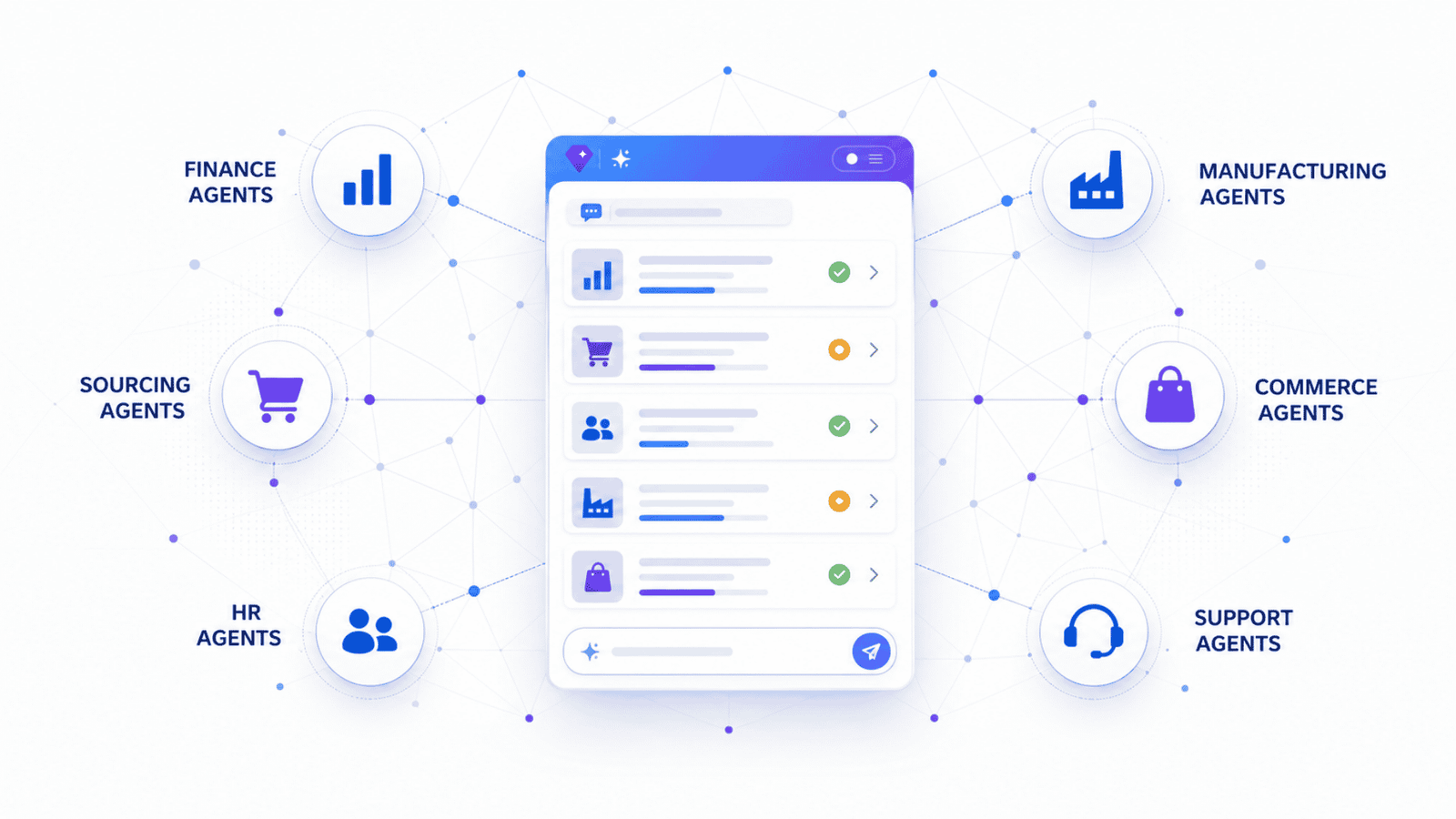
Complex work rarely lives in one department. Agents are increasingly built to hand off to each other – one flags a supply issue, another recalculates production, a third updates the financial forecast – without a human relaying messages between systems.
Put together, that’s the loop that separates an agent from ordinary automation:
The Different Types of AI Agents
Not every problem needs the same level of sophistication. Some are simple. Some require real judgment. Here’s the full spectrum, from simplest to most advanced.
Simple reflex agents
“If this happens, do that.” No memory, no planning – a direct trigger-response pattern. Good for basic access requests or straightforward alerts.
Model-based reflex agents
Like the above, but with memory of their environment – so reactions get smarter over time, not just repeated.
Goal-based agents
Plan ahead. They evaluate several possible paths, predict outcomes, and choose the sequence most likely to hit the target.
Utility-based agents
Go a step further by weighing trade-offs – optimizing for cost, speed, or quality rather than just reaching the goal.
Learning agents
Continuously refine themselves based on feedback and outcomes – well-suited to environments where conditions keep shifting.
There’s also a simpler way people describe agent behavior day to day:
For complex, multi-department work, individual agents get combined into multi-agent systems – teams of specialized agents working together on one larger process.
SAP Joule: The Front Door to All of This
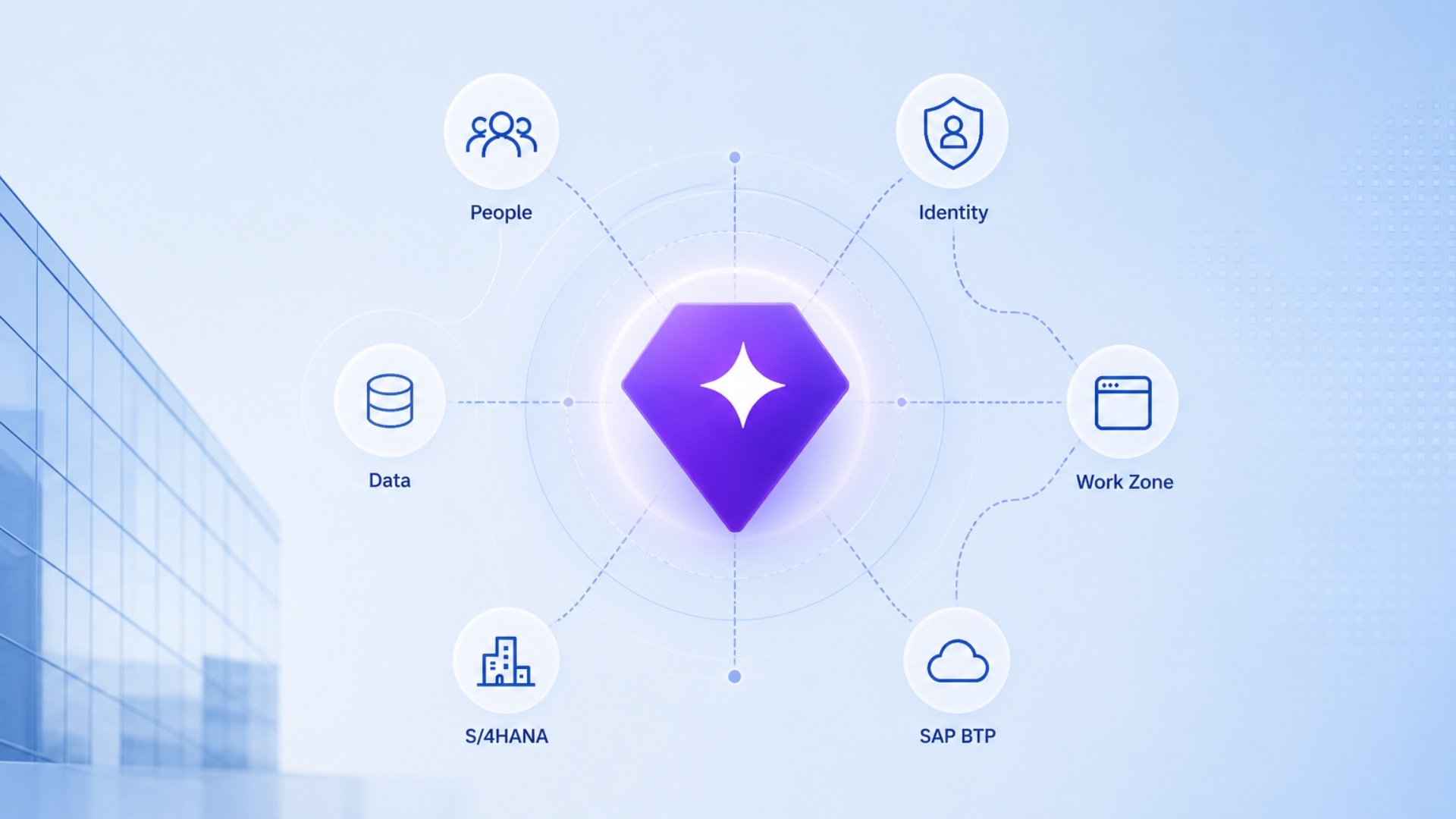
If AI agents are the workers, SAP Joule is how you actually talk to them. Instead of learning where every button and report lives inside SAP, you describe what you want in plain language, and Joule figures out which data, workflows, and agents are needed to deliver it.
Context-aware intelligence
Understands the business meaning behind a request, not just the literal words.
Cross-application integration
Bridges SAP modules that used to be siloed from each other.
Natural conversation
You talk to it like a colleague, not a command line.
Continuous evolution
The more it’s used, the better it understands how your organization actually works.
Underneath Joule sits the AI Foundation on SAP Business Technology Platform, connecting embedded SAP Business AI capabilities across S/4HANA, SuccessFactors, Field Service, Ariba, Fieldglass, and Commerce Cloud – plus room for organizations to plug in custom applications through services such as the SAP Generative AI Hub.
AI Agents vs. AI Copilots: Different Jobs, Same Team
These two get confused constantly, so it’s worth being precise:
Acts independently
Give it a goal, and it carries the work out with minimal supervision. Best for predictable, repeatable work.
Works alongside a person
Offers suggestions and assistance in real time – the human stays in the driver’s seat. Best for nuanced, judgment-heavy work.
Neither replaces the other. A mature AI setup uses agents for the routine work and copilots for the complex, human-judgment work – side by side.
Stay Ahead in the SAP + AI Era
Join 10,521+ SAP Professionals mastering SAP AI every week. No spam. Unsubscribe anytime.
Where AI Agents Are Already at Work
This is where it gets concrete. Here’s what’s actually happening, department by department.
Finance and Accounting
The problem: invoice disputes, late payments, and slow financial closes eat up huge amounts of manual time. The fix – a Dispute Resolution Agent that catches problems early instead of after they’ve caused damage:
Related use cases: late payment prediction (flags customers likely to pay late), automatic payment matching (matches payments to open invoices without manual reconciliation), and financial close resolution (spots anomalies during month-end close before they cause delays).
Supply Chain and Procurement
The problem: sourcing decisions and supplier evaluation take time the business often doesn’t have. The fix – a Sourcing Agent that identifies opportunities, evaluates suppliers, and can initiate RFPs on its own.
Related use cases: automatic invoice processing, lead time analysis to prevent stockouts, and defect detection from image data.
Human Resources
The problem: HR is buried in administrative work that pulls attention away from actual people management. The fix – a Performance and Goals Agent that pulls together relevant context automatically, so a manager walks into a 1:1 already prepared.
Related use cases: job description generation (flags biased or vague language), applicant screening at scale, interview preparation, and self-service requisition and time-off handling through plain language.
Manufacturing
The problem: production delays and equipment failures are often caught too late. The fix – a Shop Floor Supervisor Agent that spots potential disruptions before they cause downtime and recommends schedule adjustments.
Related use cases: predictive maintenance from sensor data, and quality control that catches defects and helps processes self-correct.
Marketing and Commerce
The problem: marketers spend too much time on manual campaign upkeep instead of strategy. The fix – a Catalog Optimization Agent that continuously updates pricing and listings to match how people actually search.
Related use cases: lead prioritization from purchase intent signals, customer segmentation, product recommendations, and content generation tailored to a segment and optimized for search.
IT and Governance
The problem: staying compliant and secure requires constant monitoring that’s hard to do manually at scale.
Use cases: policy enforcement, data governance (detecting inconsistencies, managing access), and security monitoring that flags unusual behavior before it becomes an incident.
Customer Support
The problem: customers expect fast, personalized answers – at a volume human teams can’t always match. The fix – a Shopping Agent that helps new customers compare products and complete orders, paired with a Q&A Agent that reads intent and answers existing customers fast.
Related use cases: ticket triage and routing, service case summarization, and real-time agent assistance during live conversations.
Sales
The problem: sales reps lose selling time to administrative upkeep.
Use cases: opportunity management, administrative automation (appointments, notes, quotes via plain language), pre-call intelligence, and automatically adjusting real-time forecasting as activity happens.
Why This Actually Matters: The Strategic Advantage
People get their focus back
Routine work moves to agents, freeing people for the judgment calls that actually need a human.
Decisions get sharper
Agents pull from more organizational data than any one person could manually review.
Departments stop working in isolation
Multi-agent systems coordinate activity across functions that used to hand off manually.
Costs go down
High-volume repetitive work gets automated with more consistency than manual processing.
Operations scale
Growing workload doesn’t automatically mean growing headcount.
Hidden patterns surface
Insights that used to stay buried in data silos come to light on their own.
How to Actually Implement This (Without Getting It Wrong)
Rolling out AI agents works best as a deliberate process, not a leap.
Pick the right first use case
Look for work that’s repetitive, error-prone, or time-consuming – invoice processing and dispute resolution are common starting points.
Check your data readiness
Agents are only as good as the data underneath them. Real-time access, clean integration, and solid governance need to be in place first.
Run a focused pilot
Choose one manageable use case, define clear success metrics – time saved, errors reduced, satisfaction improved – and measure against a real baseline.
Bring people in early
AI rollouts touch every function they affect. Business leaders, IT, and the people actually doing the work need a seat at the table from day one.
Keep humans in the loop where it matters
Define clearly where agents can act independently and where a human still needs to approve the outcome.
Build in feedback loops
Agent performance should be reviewed regularly, not set-and-forgotten – this is what keeps them improving instead of stagnating.
What This Means for the People Who Work in SAP
The honest answer: this doesn’t shrink the role of SAP professionals – it changes what the role focuses on. The people who do well in this shift will:
- Design and orchestrate agent-based systems, rather than manually operating every step themselves
- Focus more on strategic outcomes than tactical, repetitive execution
- Translate between what the business actually needs and what the technology can do
- Step in for the exceptional cases that still need human judgment
- Keep finding new places where an agent could take on more of the routine load
Some agents are simple triggers. Some plan ahead. Some optimize for cost or speed. And increasingly, they work together across finance, supply chain, HR, manufacturing, marketing, IT, and support – each handling a slice of a process that used to require a person at every handoff.
The technology is already live, already named, and already doing real work – and the organizations that get ahead aren’t the ones with the flashiest AI, they’re the ones that pick a clear, well-defined use case, get their data ready, and build outward from there.

Alma TA is SAP AI Solutions Director at Zequance.AI, specializing in SAP Business AI, Joule, AI Core, and generative AI on SAP BTP. Drawing on her background in data science and enterprise analytics, she turns complex SAP AI concepts into practical guidance for consultants, architects, and business leaders.