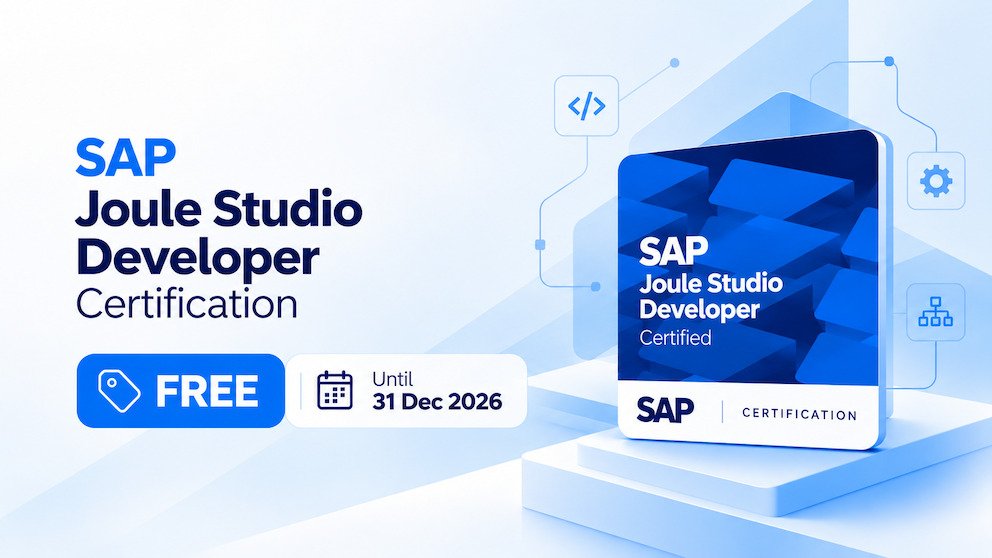
SAP Joule Studio Developer Certification: Free Until 31 December 2026
SAP is offering the SAP Joule Studio Developer certification free until the end of 2026, and it is unlike any certification exam you have taken. You share your screen, and an AI avatar watches, asks you to navigate, and questions you as you go. Here is how it works and how to prepare for it.
How the exam is structured
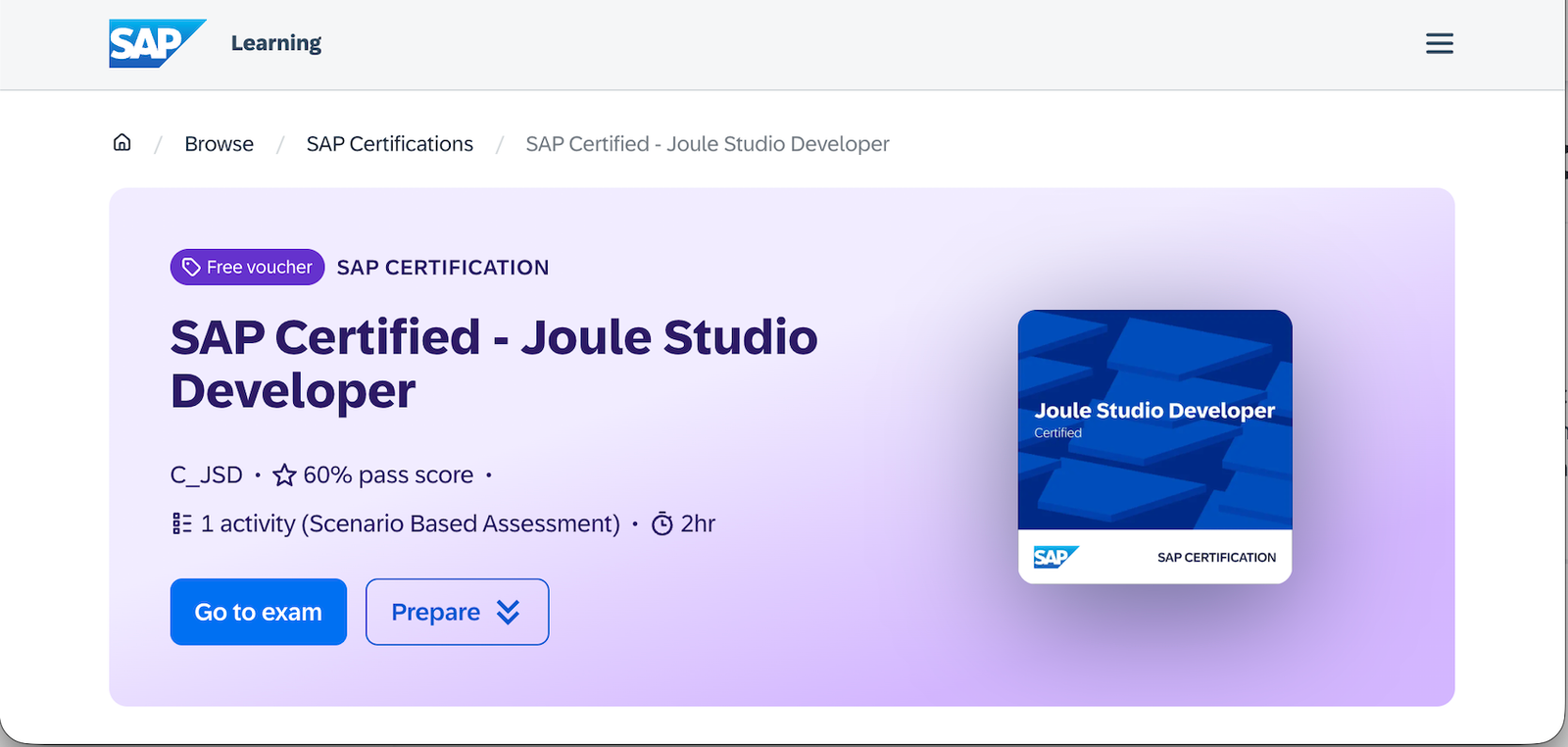
You get 2 hours and the exam has two parts. The first is practical and takes place in a live Joule Studio environment. The second is a spoken question round.
PART 1 → show your agents in Joule Studio, avatar verifies each design choice
PART 2 → avatar asks general, concept-level questions
END → session closes
Claim the exam while it is free. SAP is giving the Joule Studio Developer certification away until 31 December 2026, with one attempt per person. Registration and the current terms are on SAP’s own page.
Go to the SAP certification pageThe AI avatar: what it feels like
It is impressive. The avatar behaves like a real examiner. It looks at your shared screen, tells you where to navigate, and checks what you built against what you say you built. If you click into the wrong area, it notices. It feels like there is a person on the other side.
That has a practical consequence: you can’t bluff. You need to be able to show every piece of your work and explain it as you go.
Part 1: the hands-on practical
The practical centres on two build tasks in Joule Studio, SAP’s low-code environment for building agents and skills:
The avatar asks you to open different parts of each agent’s design and validate how you defined it. Be ready to show and explain the agent’s purpose and instructions, the tools or actions it can call, and how your extension changes the standard agent without breaking it.
Part 2: the verbal questions
After the practical, the avatar asks a set of questions. They are general and conceptual, not tied to your specific practical assessment work you’ve done. Expect them to cover SAP’s AI agent governance, open standards like Agent to Agent protocol, MCP, AI workflow design, monitoring, and human oversight. You answer out loud, so practise speaking your answers, not just reading about the topics.
8 practice questions, with answer guidance
The questions below are written in our own words, not SAP’s based on our experience of completing the exam. It will help you prepare for the exam.
What is the SAP AI Agent Hub, and which problem does it address in a company that is already running AI agents in several departments?
Think of it as a central place to discover, manage and govern AI agents across the organisation. The problem it solves is sprawl: many agents in many departments, with no shared view of who owns what, what each can do, or how it is behaving.
Structure: problem (sprawl) → what the Hub provides (visibility, governance, monitoring) → business benefit (control and trust at scale).
SAP backed the open A2A and MCP standards rather than building protocols of its own. What does that decision mean for an enterprise, architecturally and strategically?
Open standards reduce lock-in and let AI agents from different vendors work together. A2A is about agents communicating with other agents; MCP is about connecting agents to tools and data. Strategically, enterprises can mix SAP and non-SAP agents and tools without custom integration for each pairing. The trade-off is that you need to govern a more open ecosystem, which is where the architecture choices behind generative AI on SAP BTP start to matter.
Structure: what each standard does → architectural benefit (interoperability) → strategic benefit (less lock-in) → the governance trade-off.
A company runs around a dozen Joule agents across finance, procurement and HR. How would you keep them governed and inside their intended scope as the business keeps changing?
Give every agent a clear owner and a defined scope. Review permissions and access regularly. Monitor behaviour against the intended scope, and run a change process so that when business needs change, the scope change is approved, tested and documented before it goes live.
Structure: inventory and ownership → scope and permissions → monitoring → controlled change.
A team wants its Joule agent to work with an external forecasting application. Which open standard would you point them to, and on what basis?
The key distinction is tool access versus agent-to-agent communication. If the forecasting tool is something the agent should call for data or a calculation, that is the tool-and-data-connection case (MCP). If the forecasting tool is itself an agent that needs to collaborate, that is the agent-to-agent case (A2A). State your assumption, then give the recommendation and the reason.
Tip: naming the assumption out loud shows the examiner you understand the difference.
You are mapping out a procure-to-pay process. Which steps would you hand to an autonomous agent, and which belong with a conversational one?
Autonomous agents suit rule-driven, high-volume tasks with clear outcomes, such as matching invoices to purchase orders and goods receipts, or flagging exceptions. Conversational agents suit work where people ask questions, make judgment calls or approve exceptions, such as a buyer querying supplier status or a manager approving an out-of-policy purchase. Our round-up of SAP AI use cases across business processes is a useful source of examples here.
Structure: a simple rule (repeatable and rule-based vs judgment-based), two or three examples of each, and where a human approves.
An agent behaved well in testing but returns inconsistent recommendations once it is live. How would you use Agent Hub monitoring and observability data to track down the cause?
Investigate in order: compare production inputs with test inputs (real data is messier); review monitoring and observability data for patterns such as specific tools failing, latency, or particular input types; trace individual inconsistent runs step by step; check whether instructions, tool definitions or underlying data changed; then fix, retest and monitor again.
Structure: a clear sequence of steps. Examiners reward a methodical process.
How does governance differ between an agent you build yourself in Joule Studio and an SAP-delivered line-of-business agent that you have extended?
With a custom agent, your organisation owns the whole design and therefore the whole governance burden: scope, testing, change control, lifecycle. With an extended SAP-delivered agent, SAP provides the foundation and you govern what you add or change, so the focus is on keeping extensions compatible and controlled as the standard agent evolves.
Structure: who owns what in each case → where the risk sits → how updates are handled.
SAP positions AI as something that supports human decisions, particularly in regulated processes. Where does that sit uneasily with the drive toward autonomous agents?
There is a real tension: full autonomy maximises speed, while regulated processes need accountability and the ability to explain a decision. Resolve it by matching autonomy to risk: let agents act on low-risk, reversible steps, and require human approval, with an audit trail, where the stakes or regulation are high. Autonomy is a dial, not a switch. SAP’s own position on this sits inside its wider SAP Business AI approach.
Structure: acknowledge the tension → risk-based autonomy → human approval points and audit trail.
How to prepare
SAP publishes a Developing with Joule Studio learning journey that covers the material the practical draws on, and the free voucher FAQ sets out the current terms, eligibility and the 24-hour rule.
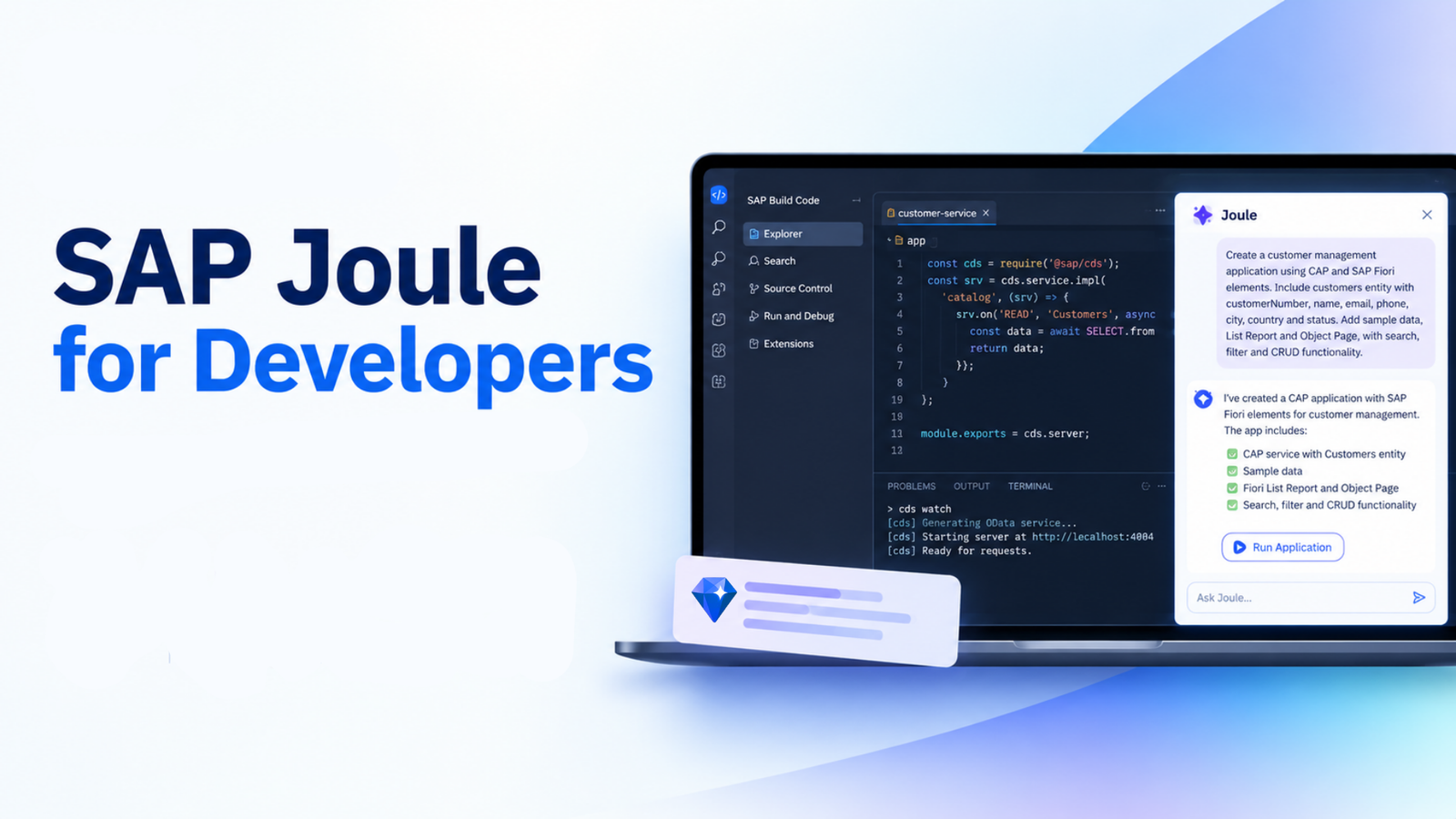
If you are deciding between this and SAP’s other AI credentials, our guide to the SAP AI certification paths compares the developer and consultant routes. The C_AIG 2026 generative AI developer exam moved to a task-based format as well, so the same preparation habits apply. For broader background on what Joule can do day to day, see our guide to Joule for Developers.
Key takeaways
- The certification is free until 31 December 2026, with one attempt per person.
- Two hours, two parts: a live practical on screen share, then spoken conceptual questions.
- The AI avatar is realistic and verifies your work, so you need to be able to show and explain everything you built.
- The verbal round is general: governance, open standards, agent design, monitoring and human oversight.
- Structure beats volume. Give a clear framework for each answer.
Want guided preparation? The SAP AI Masterclass covers the concepts behind these themes, with exam preparation for the SAP AI certification, taught by former SAP professionals.
Explore the SAP AI MasterclassPrefer a weekly digest? Get the free SAP AI newsletter at zequance.ai/news.
This article is independent and is not affiliated with SAP. It describes a candidate’s experience and general guidance, and does not reproduce exam content. Always refer to SAP’s official certification page for current requirements.

Alma TA is SAP AI Solutions Director at Zequance.AI, specializing in SAP Business AI, Joule, AI Core, and generative AI on SAP BTP. Drawing on her background in data science and enterprise analytics, she turns complex SAP AI concepts into practical guidance for consultants, architects, and business leaders.