Kickstart Your Journey with SAP AI: Part 3 Fundamentals of Deep Learning
Introduction
By now, you’ve already learned about Artificial Intelligence (AI) and Machine Learning (ML). You understand how AI can help a robot find your lost toy and how ML lets it learn from examples. Now, we’re going to dive even deeper into a special kind of Machine Learning that is Deep Learning.
So, if Machine Learning is like teaching a robot to recognize your toys, then Deep Learning is like giving that robot a superpower—it can learn to recognize anything by itself, just by looking at lots of examples, even without you having to explain what each thing is. Let’s explore how this works!
This 7 part blog series is designed for anyone who wants to start learning about SAP AI. No matter what your job is or what you do, understanding the basics of Generative AI how it connects to SAP is a smart choice.
In this blog series, we’ll break down SAP AI into easy-to-understand parts, covering one step at a time.

What is Deep Learning?
Imagine if a machine could learn just like you do! That was the big idea behind creating something called “Deep Learning.”
Deep Learning is a special kind of machine learning, which is part of something even bigger called Artificial Intelligence (AI). It’s like teaching a computer how to think a little bit like a human brain!

Deep learning uses something called an Artificial Neural Network (ANN), which works a bit like how our brains connect and think. These networks help machines recognize patterns, solve problems, and even make decisions, just like we do when we learn new things!
First, lets understand a few important concepts,
Your weekly SAP AI brief
10,521+ SAP professionals read it every week. One SAP AI briefing a week: what SAP shipped, what it means for your role, and one thing to try.
Free. No spam. Unsubscribe anytime.
Biological Neural Network in the Human Brain
The human brain is like a supercomputer! Its most important building blocks are called neurons. There are billions of neurons in our brain, all connected, forming a neural network. Think of it like a giant web of wires, where each wire passes signals between different points.
Neurons take in inputs from everything we experience—what we see, hear, or even feel—and send messages to other neurons. These messages help us think, react, and most importantly, learn new things!

Artificial Neural Network (ANN)
Let’s simplify an Artificial Neural Network by imagining a classroom of students working together on a big project. Each student in the class represents a neuron, and they all have to talk to each other to complete the project.
Each student gets some information (like a task or a question) from the teacher. They work on it and then pass their answer to the next student. Some students do simple tasks, while others work on more complex parts. In the end, the final student collects all the information and presents the complete solution.
The information the students pass around is like data, and the students are like neurons in the ANN.
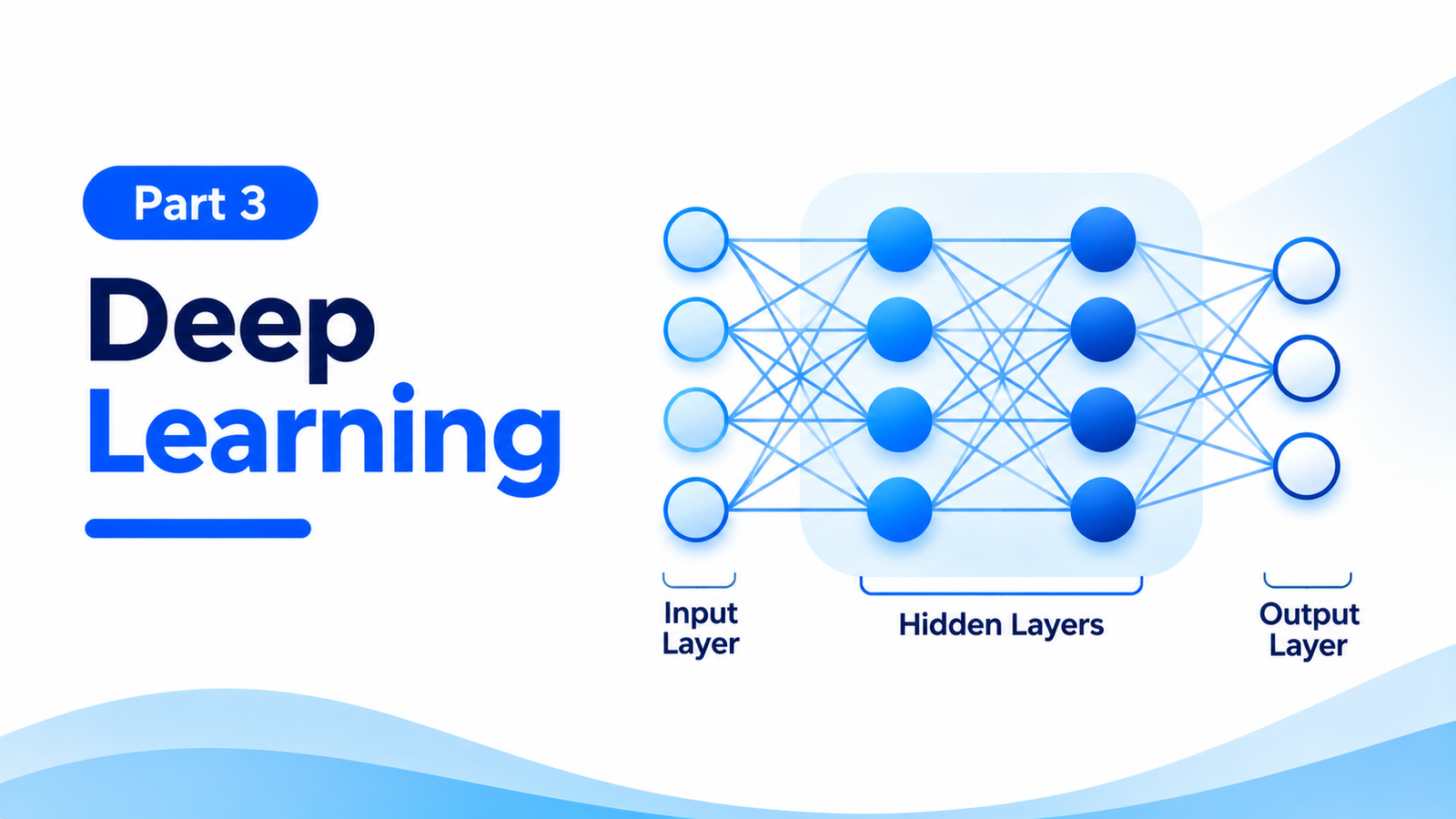
Architecture of an Artificial Neural Network
Now, let’s break down the layers of this “classroom network”:

In a Nutshell:
By thinking of an ANN as a classroom where students (neurons) collaborate to solve a problem, it becomes easier to understand how deep learning works!
How Does an Artificial Neural Network Work?
Imagine a group of students trying to identify a type of fruit by sharing their observations.
Each student focuses on specific features, such as color, shape, and texture.
Individually, they might not fully figure out what fruit it is, but by combining their insights, they can arrive at a collective understanding.
In the world of artificial neural networks, these students represent neurons.
In an artificial neural network, individual neurons (like the students) specialize in recognizing specific aspects of the input. When combined, they contribute to recognizing the overall object (like the fruit). The network improves over time, just as the students get better at identifying fruits with more practice.
If they correctly identify an apple, they earn points. If not, they learn from their mistakes and adjust their approach next time. Similarly, in a neural network, a scoring approach is used to adjust the network’s parameters to improve its accuracy over time.
This teamwork illustrates how artificial neural networks process information step by step, learning from various features and refining their understanding through each attempt.
Deep Neural Networks
A Deep Neural Network (DNN) is a type of Artificial Neural Network (ANN) that has multiple layers between the input and output.
The term “deep” means it contains several layers, which allows it to learn more complex patterns compared to a simpler network.
Key Points about Deep Learning
Let’s summarize some important concepts about Deep Learning:
Machine Learning vs Deep Learning


SAP AI Skills
Very few have SAP AI skills.
Summary
In this blog, we explored what deep learning is and how it functions. Deep learning gets its name from the multiple layers in its neural networks, similar to the way the human brain processes information through layers of interconnected neurons. Each layer adds to a deeper understanding of the data it handles.
From recognizing images and understanding speech to powering voice assistants and self-driving cars, deep learning has proven to be highly effective at solving complex problems across various fields.

Alma TA is SAP AI Solutions Director at Zequance.AI, specializing in SAP Business AI, Joule, AI Core, and generative AI on SAP BTP. Drawing on her background in data science and enterprise analytics, she turns complex SAP AI concepts into practical guidance for consultants, architects, and business leaders.