
SAP AI in 2025: How AI Agents Will Transform SAP Systems
In January 2025 we named five themes that would shape SAP AI over the year: AI agents, context-rich models, adoption at scale, AI as the user interface, and regulation. It is now November 2026, so we went back and checked how each one played out. Agents and the interface moved fastest, and regulation got more time than planned.
AI agents: from assistants to autonomous agents
What we said in January 2025: search-style assistants would give way to multi-agent systems that plan, reason and work across systems.
That is the part that happened most clearly. At Sapphire in May 2026, SAP said its Autonomous Suite would bring more than 50 domain-specific Joule Assistants across finance, supply chain, procurement, HR and customer experience, and that these assistants orchestrate a subset of over 200 specialized agents (SAP's announcement). A few weeks earlier, SAP's Q1 2026 notes put Joule across 35 solutions, with more than 30 specialized agents and more than 2,500 Joule Skills (Q1 release highlights). The two counts come from different documents and dates, so read them as a direction rather than one exact number.
The "work with other systems too" part of our prediction is also on the record. SAP describes agent-to-agent interoperability with Google Cloud and Microsoft, and an AI Agent Hub to discover, manage and govern agents. If you want the basics of how these agents are built, our simple guide to AI agents in SAP is the place to start.
ASSISTANT → a Joule Assistant takes the task
AGENTS → specialized agents do the steps
SYSTEMS → SAP and connected systems are updated

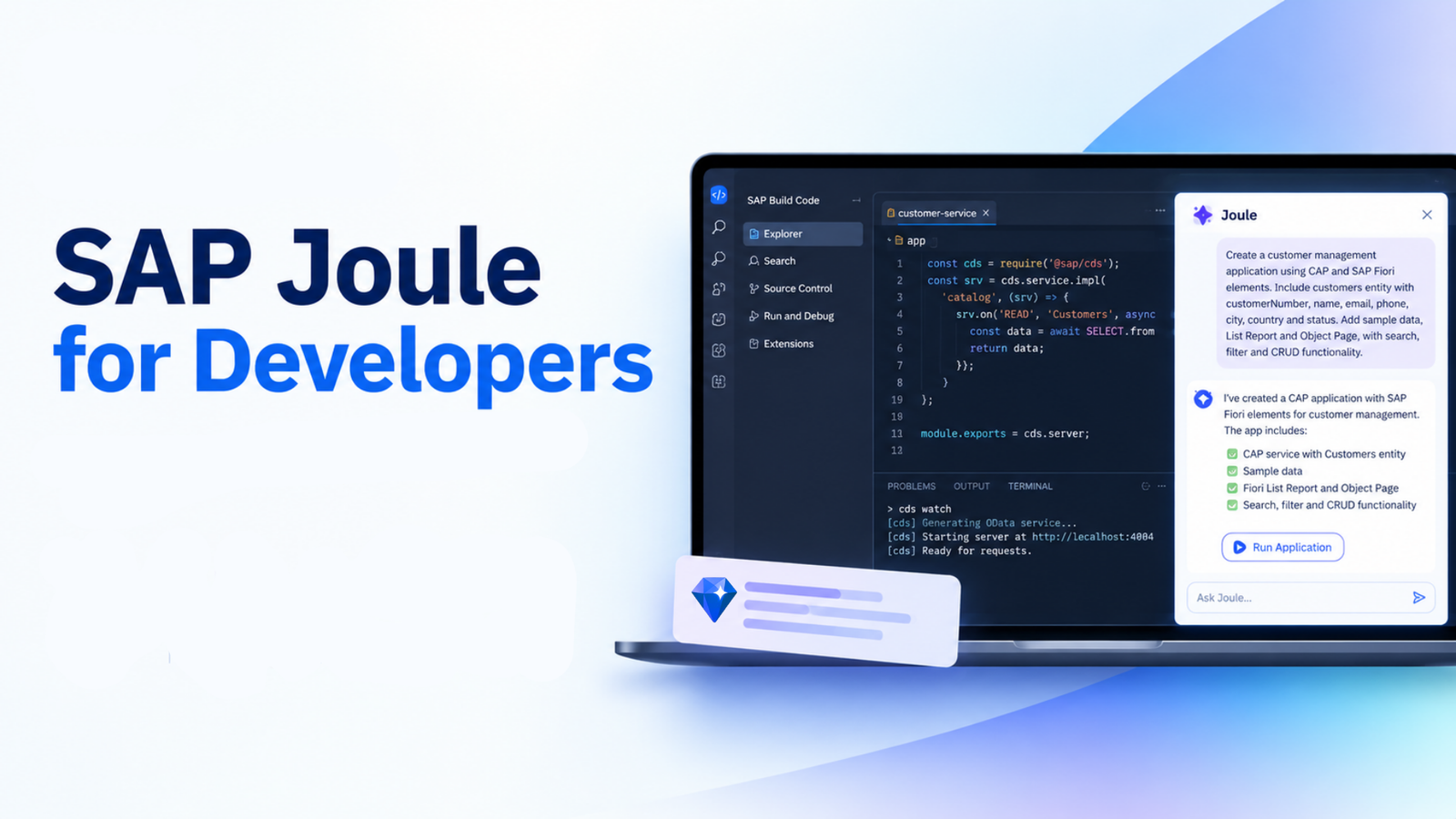
Building your own agents also got easier. SAP's new Joule Studio is a managed offering for the full life cycle of agents and workflows, and SAP says design-time access is free for customers and partners through the end of 2026 (SAP's Joule Studio post). We covered the no-code starting point in our Joule Studio explainer.
Your weekly SAP AI brief
10,521+ SAP professionals read it every week. One SAP AI briefing a week: what SAP shipped, what it means for your role, and one thing to try.
Free. No spam. Unsubscribe anytime.
Models: context won over size
What we said in January 2025: the winners would not have the biggest models, but the richest context.
SAP's own architecture now says the same thing. Its Business AI Platform brings SAP Business Technology Platform, SAP Business Data Cloud and SAP Business AI into one governed environment, with the SAP Knowledge Graph at the core. In plain words, that gives agents a structured map of your business entities, processes and relationships instead of leaving them to guess (SAP's announcement). The data layer underneath is SAP Business Data Cloud, which we explained when it launched.

Two other signals point the same way. SAP's Q1 2026 notes add Google Drive to Joule's document grounding, with up to 8,000 documents per pipeline, and the Generative AI Hub now lists models from OpenAI, Google and Anthropic. Model choice widened while the grounding work became the real differentiator. If you want to try grounding yourself, our Generative AI Hub guide shows the free route, and SAP RPT-1 is a good example of a model built for structured business data rather than general chat.
Adoption: from hype to reality
What we said in January 2025: the question would change from "should we use AI?" to "how do we use it on our biggest problems?"
SAP's release notes now read like adoption reports, with measured results attached to specific agents and assistants. These are SAP's own figures, so treat them as vendor claims, but they show where the effort is going: finance, procurement and supply chain tasks that repeat all day.
SAP is also putting money behind rollout. It announced a €100 million fund for partners who help customers deploy SAP-built assistants and agents. Our walkthrough of the Autonomous Enterprise vision explains the idea behind these assistants as a simple chain of events.

AI as the new user interface
What we said in January 2025: you would tell the system what you want, instead of clicking through screens.
This is now SAP's stated direction. With Joule Work, SAP says users will interact primarily with Joule, which orchestrates workflows, data and agents from a business outcome, on desktop, mobile and voice, across SAP and non-SAP systems. Our Joule explainer covers how natural-language access works day to day, and conversational reporting in SAP Analytics Cloud shows why a simple question needs a governed setup behind it.
Our read: announced is not the same as adopted. How much of your daily work moves into Joule depends on which assistants are live in your release and landscape, so check that before planning around it.

Regulation: more time, same direction
What we said in January 2025: rules would be fragmented, and companies that use AI responsibly would earn trust and an edge.
The rules did change, mostly in timing. According to a K&L Gates summary, the EU's AI Omnibus (Regulation (EU) 2026/1744) was published on 24 July 2026 and entered into force on 27 July. It moves the stand-alone high-risk obligations, such as those for employment and credit decisions, from 2 August 2026 to 2 December 2027, and AI built into regulated products to 2 August 2028. Transparency duties still apply from 2 August 2026 (K&L Gates article on Mondaq). That is one law-firm source, so confirm the dates in the Official Journal before you plan around them.
Governance is also moving into the product. SAP describes sandboxed agents with configurable guardrails and monitoring of agent usage and cost, which fits the ethical approach we outlined in our SAP Business AI fundamentals.

Looking ahead from late 2026
The 2025 question was whether SAP AI would move from experiments to real work. The 2026 question is narrower: which assistants and agents reach your own landscape, and who governs them once they do. The practical first step is readiness, meaning the platform, identity and data foundations that Joule depends on. Our guide to Joule integration with S/4HANA walks through that groundwork.
For consultants, the shift is about skills. Fewer people will be asked to find a screen, and more will be asked to design, check and govern what an agent does. That is where the five themes above meet your own career.
Key takeaways
- Agents: SAP now talks in terms of 50+ Joule Assistants orchestrating 200+ specialized agents.
- Context: the SAP Knowledge Graph and Business Data Cloud make grounding the core of the platform.
- Adoption: results now come as per-agent figures, but they are SAP's own claims.
- Interface: Joule Work is SAP's stated direction, so check what is live in your release.
- Regulation: EU high-risk deadlines moved to December 2027 and August 2028, while transparency duties still start in August 2026.
We keep our SAP AI posts current. To get each new update, subscribe to our free SAP AI newsletter at zequance.ai/news, or follow our free SAP AI tutorials on YouTube.
If you want guided learning, the SAP AI Masterclass covers the SAP AI concepts behind these themes.

Alma TA is SAP AI Solutions Director at Zequance.AI, specializing in SAP Business AI, Joule, AI Core, and generative AI on SAP BTP. Drawing on her background in data science and enterprise analytics, she turns complex SAP AI concepts into practical guidance for consultants, architects, and business leaders.